
01
Discreet emergency mode
An everyday-looking experience designed to allow discreet initiation of a protection protocol when the person cannot openly show they are seeking help.
Technology for personal protection and trust networks
Angelus Guardian is a technology initiative created to strengthen trust networks and support faster responses in contexts of violence against women, gender-based violence and femicide risk.
Angelus is a complementary support tool and does not replace the police, emergency medical services, firefighters or official emergency services. In immediate danger, also contact your local emergency services.
01
An everyday-looking experience designed to allow discreet initiation of a protection protocol when the person cannot openly show they are seeking help.
02
A coordination environment between the protected person and their trusted guardian network, with routines, protection journeys, temporary accompaniment, contextual location and alerts.
Angelus is a complementary support tool and does not replace official emergency services.
Some situations don't allow a phone call, a long explanation or visible interaction with your device.
Angelus turns discreet actions — an alternate code, a single tap, a missed check-in — into a coordinated protection journey: silent alerts, context shared according to the protocol and follow-up by trusted people.
Network preparation and discreet response when it matters.
The protected person organizes their trusted guardian network.
Prepares a routine or protection journey.
Shares temporary accompaniment when needed.
Guardians receive context and alerts according to the protocol.
The incident is closed clearly.
Different triggers, manual and automatic, for different risk situations.
Immediate manual activation.
Enter an alternate code and ask for help without raising suspicion.
Lets you set an arrival time and a tolerance window. If arrival is not confirmed by the deadline, Angelus can notify your configured guardians — without stating a confirmed emergency.
Guardians can be notified when the device is about to shut down. Available in controlled beta validation.
The system logs network interruptions during an incident. Available in controlled beta validation.
Resending and broadening alerts when necessary. Available in controlled beta validation.
Fictional scenarios show how Angelus protocols and signals can support a trusted network at different moments.
Protection comes first. Discreet protocols and protection journeys support the trusted network.
When discreet emergency mode is triggered, the network receives maximum priority — with no visible emergency interface on the device.

1 of 5
Camila senses immediate risk leaving a meeting and must act without drawing attention.
Under coercion, a preconfigured protection shortcut can start help without revealing the trigger.

1 of 5
Lucas is at a work dinner and cannot raise suspicion while asking for help.
An apparently ordinary routine can mask a help request in the background.

1 of 5
Daniela must simulate routine while alerting trusted people.
A preconfigured code unlocks the app normally while a silent alert reaches the network.

1 of 5
Beatriz must unlock the device without showing fear.
Presentation narrative about prioritizing alert delivery through available channels — without promising absolute availability.

1 of 5
An event requires the network to be reached quickly through configured channels.
Marina leaves work at 7 p.m. and schedules her arrival one hour later. If the deadline and tolerance end without confirmation, her network receives an attention notice.
Marina schedules arrival and tolerance; if the deadline ends without confirmation, the network gets an attention notice — not a confirmed emergency.

1 of 5
Before leaving, Marina sets departure, destination and arrival window.
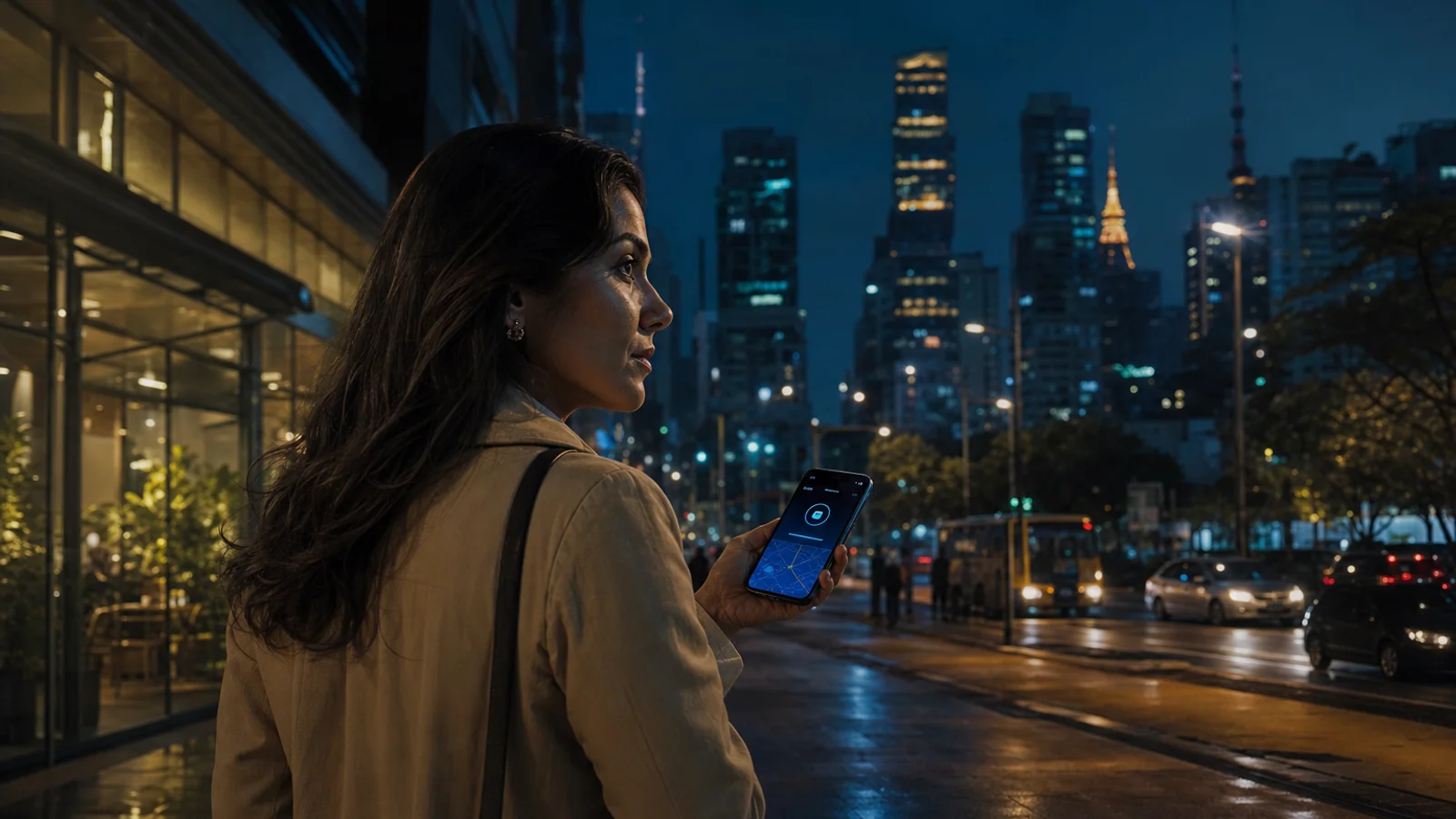
A gentle reminder before or at the expected confirmation moment — not an emergency or missed check-in.
1 of 5
Marina is close to the agreed arrival time.
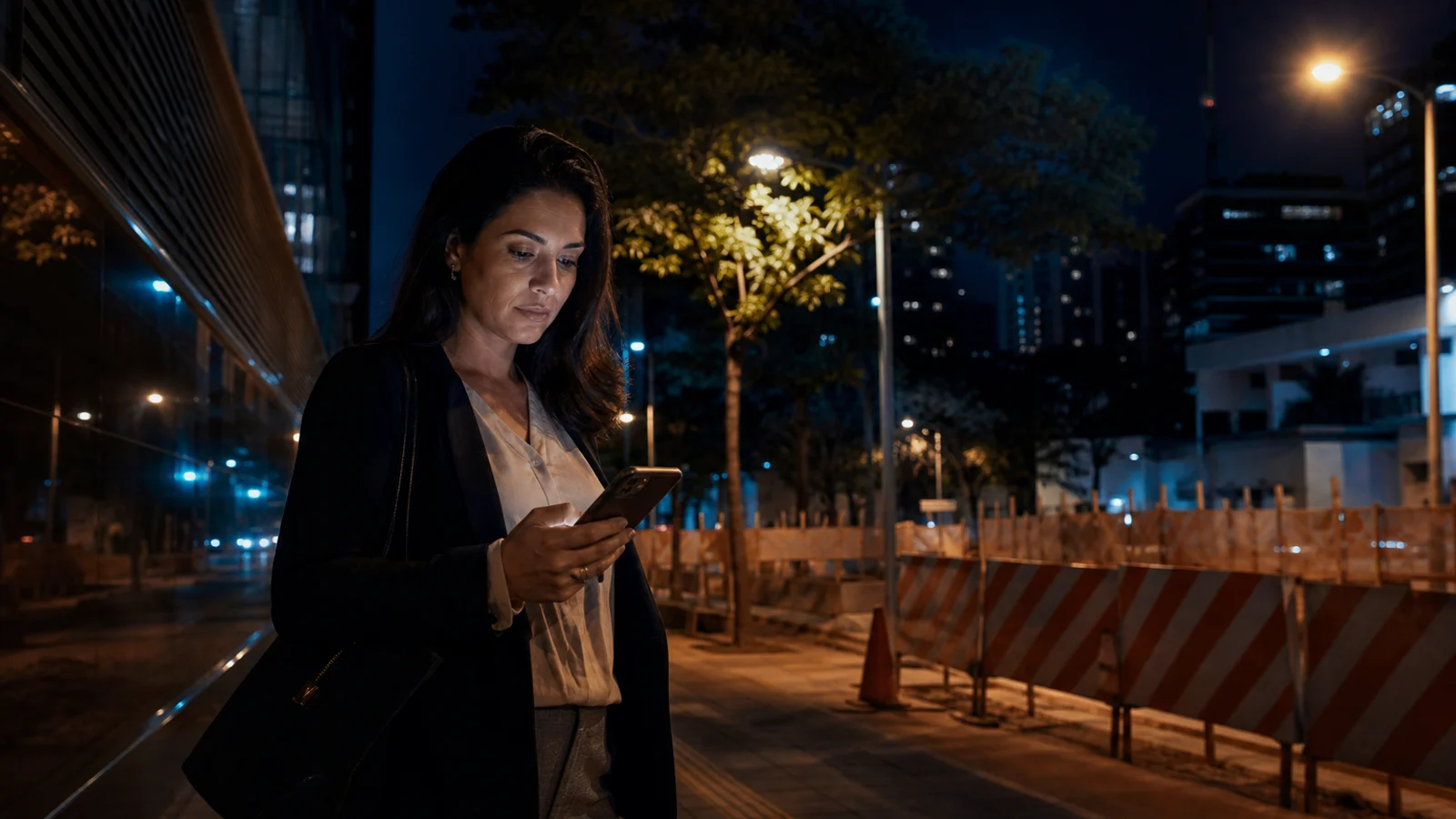
Marina consensually changes the active journey deadline; the network sees the new expected time.
1 of 5
A legitimate delay requires more time than planned.
Missing confirmation does not prove an emergency — it only signals a pending confirmation.
Follow-up signals help the trusted network interpret the quality and continuity of information received.
A limited device capacity signal — not a manual trigger.

1 of 5
Rafaela is still en route with the device active.
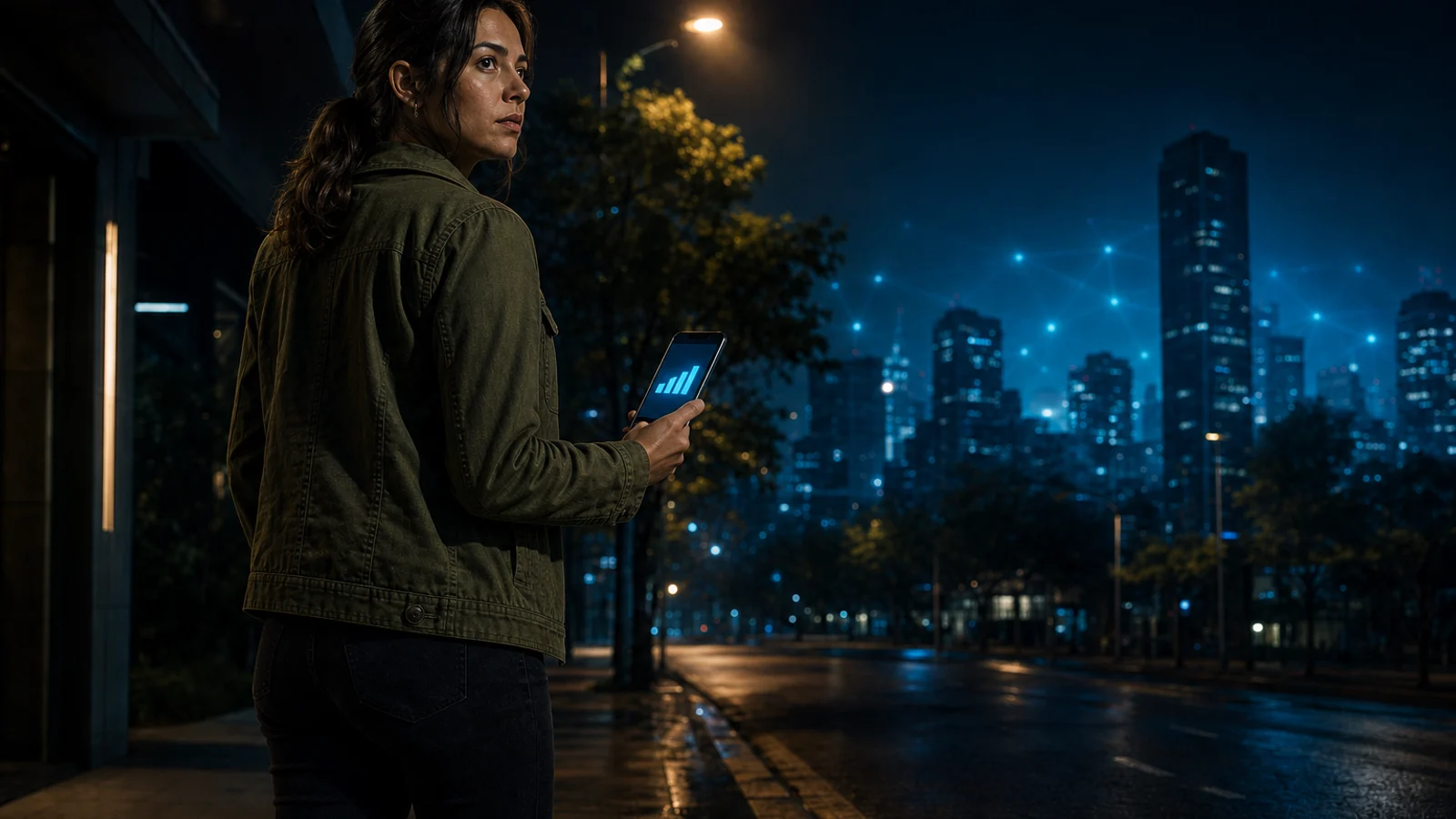
Network loss during an occurrence; the last known position is preserved.
1 of 5
The device was sending updates normally.
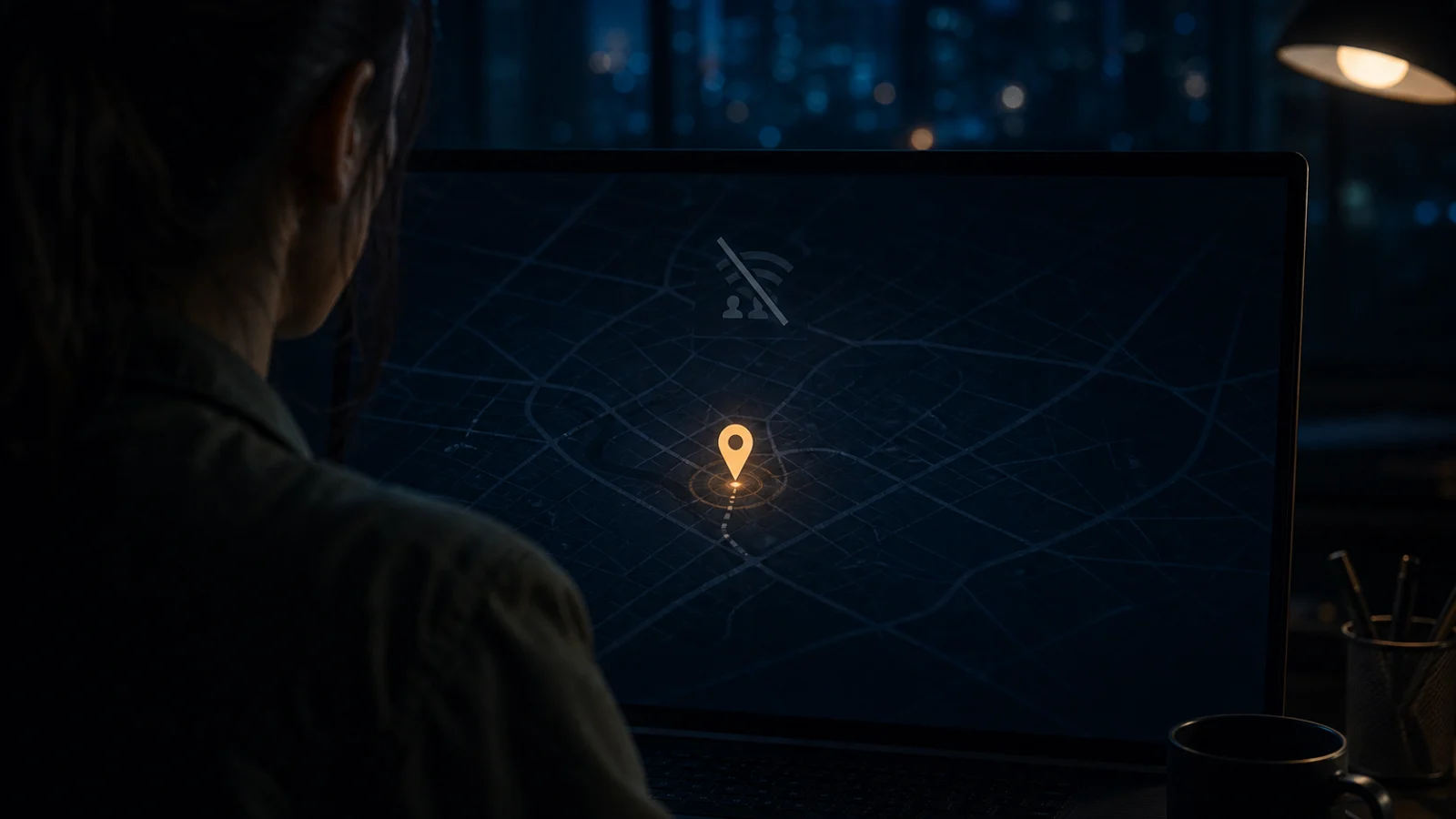
Signal returns and updates resume from the latest point — without inventing missing history.
1 of 5
The network follows the last known position.
No new ping for a relevant period — distinct from total connection loss.
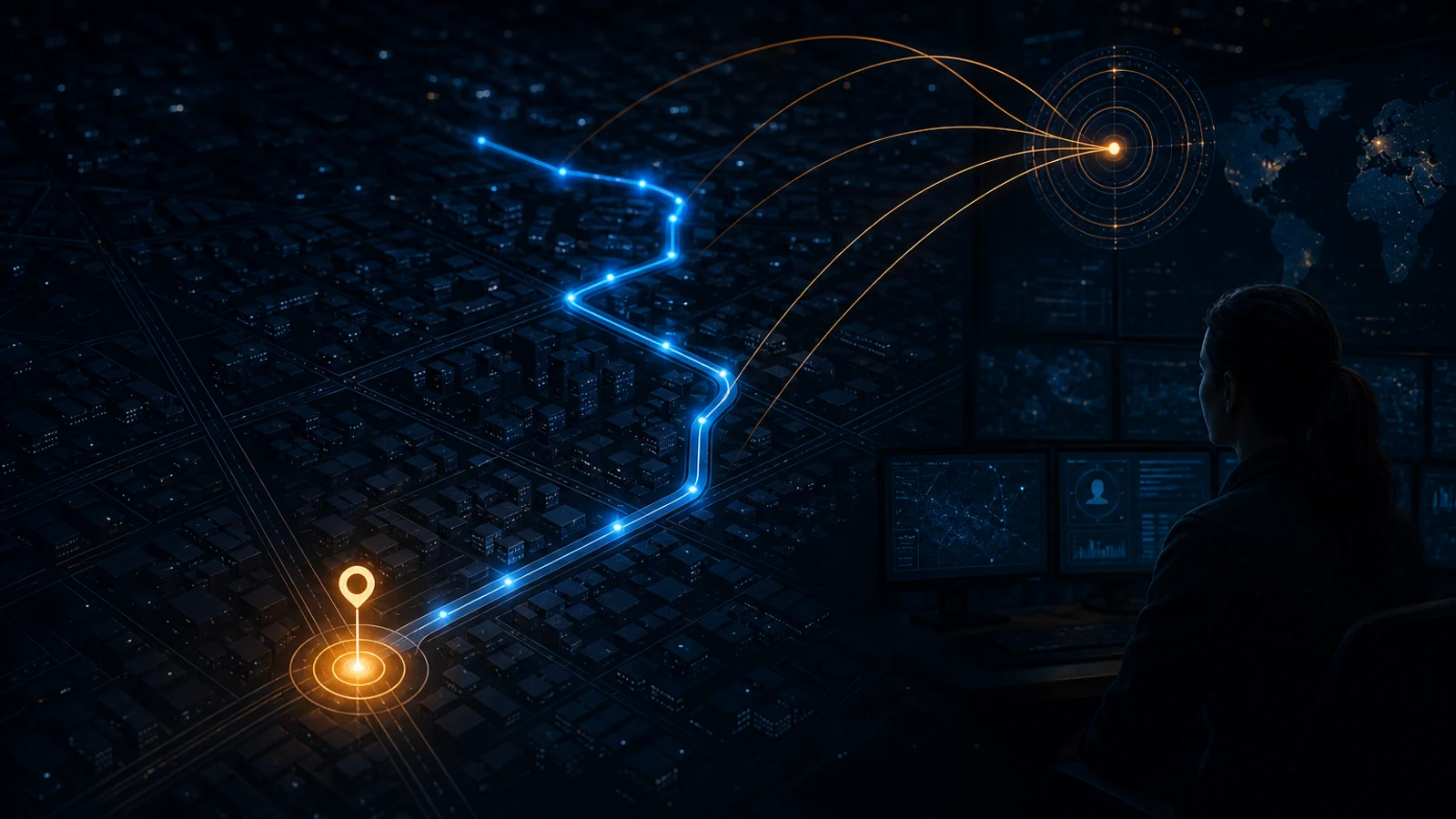
1 of 5
The network was receiving pings at short intervals.
The device stopped authorizing location — distinct from temporary inaccuracy or network loss.

1 of 5
A follow-up session was in progress.
Revocation, guardian confirmation, alert delivery and closure — each state has a distinct meaning.
A critical alert or invite is no longer valid — distinct from a safe closure.

1 of 5
The network was following a high-priority occurrence.
A guardian explicitly states “I am monitoring” — idempotent confirmation without duplicate records.

1 of 5
The guardian opens the secure link for the first time.
Failure delivering alert, email, push or invite — not confused with food delivery.

1 of 5
The system tries to reach a guardian by push or email.
Final closure of the occurrence — distinct from revoked alert or mere reconnection.
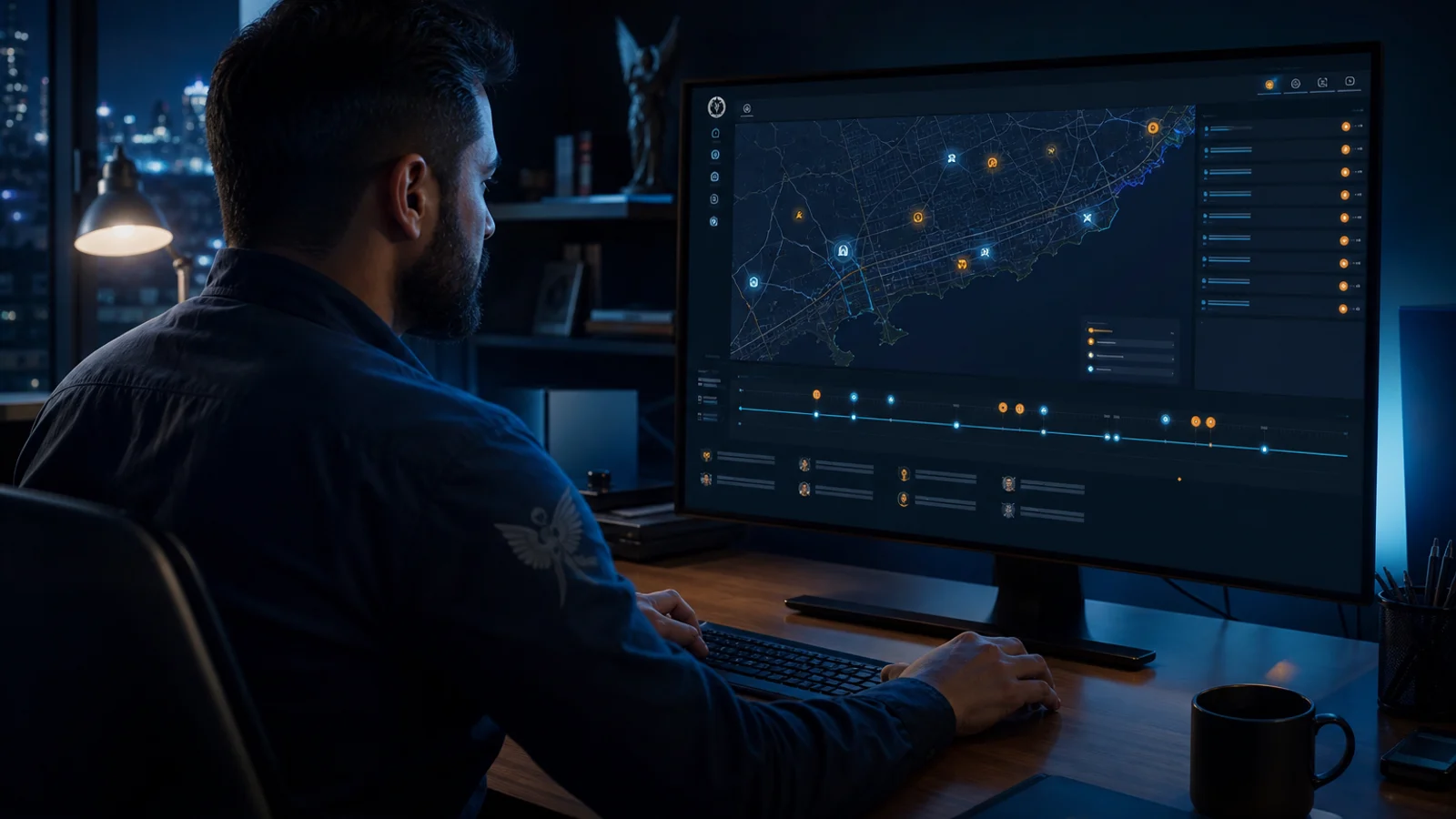
1 of 5
Guardians still follow signals in near real time.
Follow an active incident, review recent updates and see which guardians opened or confirmed follow-up.
Availability depends on connectivity, permissions and Beta stage. Does not guarantee continuous monitoring or automatic safety confirmation.
Notice progression between network levels — capability in development, without promising full operation.

1 of 5
The alert reaches the configured primary guardian.
Expanded coordination, history and automation are evolving in Angelus — without turning the protection core into an upsell.
Learn about AngelusNot every situation calls for the same kind of response — that's why Angelus combines direct protocols, discreet tools and scheduled follow-up.
Angelus does not replace police, emergency services, healthcare or specialized support. Guardians follow along via the secure link.
Enter an alternate code and keep acting normally. Angelus starts the emergency protocol in the background, with no visible alerts on the screen.
Unlocks the app normally, without triggering any alert.
Unlocks the app and starts a silent alert to your guardians, with no visible sign on the device.
Flows designed for stressful moments, with fast and discreet activation.
Activation with no visible signs on the device.
Tokenized, temporary links, only for your guardians.
The incident timeline is recorded for reference.
Guardian views and confirmations may be recorded depending on configuration.
Realtime with redundant polling as a safety layer.
You know what happens to your data at every step. No black boxes, no hidden access.
Angelus was designed for contexts where audio, calls, or speech may not be viable.
Explore accessibility featuresAngelus Guardian does not replace police, ambulance, fire services, or official emergency services. Features depend on connectivity, device permissions, battery, channel availability, and correct setup of trusted contacts.
Preferences and instructions help guardians prioritize messages over calls.
Alerts and confirmations reduce reliance on sound, speech, or long explanations.
People who follow along receive clearer guidance and fewer assumptions.
Preferences enabled by the person themselves, editable, and shared only with trusted guardians.
Secure follow-up through a temporary link, with nothing to install.
View panel demoProtection does not require installing another app. The secure link remains a central option for guardians.
Push notifications and background behavior vary by device, permissions and Beta stage — we do not promise delivery in every scenario without E2E validation.
Privacy isn't just a feature, it's our foundation. Data transmitted during an incident is protected in transit and at rest, on infrastructure monitored according to operational practices.
Communication protected by HTTPS/TLS, session-based access control and monitored infrastructure.
After closure, operational access stops and the panel shows the final state defined by the incident policy.
A record of who accessed each incident's data, ensuring transparency and shared control.
Protection layers
The project is preparing for controlled beta testing. You can understand how it works and, if you wish, express interest in the beta — with no promise of immediate access.
Angelus Guardian is an independent project created by Carlos Vaz, combining mobile development, web architecture, artificial intelligence, and experience design to turn a social need into a working platform.
Carlos Vaz
Web Developer · AI-Assisted Software Builder
Independent project combining product, interface, and AI-assisted engineering.